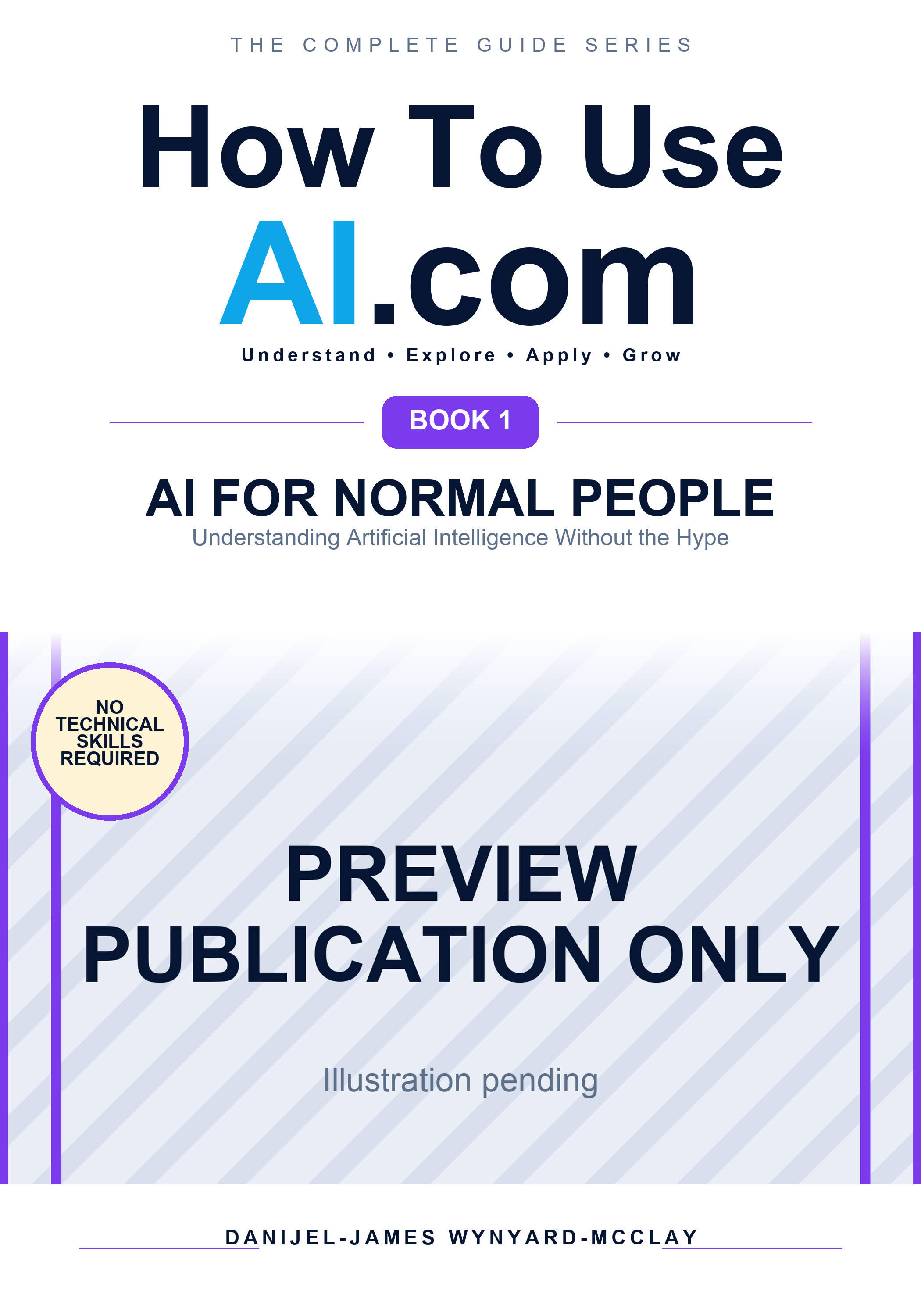
Book 1 · No technical skills required
AI for Normal People
Understanding Artificial Intelligence Without the Hype
A genuinely non-technical starting point for people who want to understand what AI is, what it can do, where it fails, and how to use it with sound judgement.
AI can draft an email, summarise a meeting or offer an idea in seconds. Knowing what to ask—and what to check—is where your judgement comes in. This book helps you find that footing.
Releases
Four parts · 14 chapters · Epilogue: Don’t Panic
You don’t need an AI hobby to understand AI.
For the curious, the sceptical and anyone who feels the conversation has moved ahead without them.
Perhaps you’ve never opened a chat assistant. Perhaps you use one at work but wonder how much of its answer to trust. Or perhaps you’re tired of being told that AI will either solve everything or take everything away.
The book starts with things you already recognise and works towards decisions you can make for yourself. No coding, no maths lessons and no expectation that you’ll follow every new product announcement.
What you’ll take away
- A clearer understanding of what AI can and cannot do.
- A practical way to ask for help, inspect the result and improve it.
- Questions to ask before sharing information or relying on an answer.
- A way to assess tools and claims without chasing every trend.
A guide from first questions to everyday decisions.
Explore the four parts. Open a chapter to see what it covers.
Part 1
What AI Actually Is
Start with familiar technology and build a clear picture of what sits behind the conversation.
1. You’ve Already Been Using AI
Recognise AI in recommendations, navigation, spam filters and fraud alerts. Understand the book’s starting point: pattern recognition at scale.
2. Why Everyone Suddenly Talks About AI
Follow the developments that made AI visible, accessible and commercially important—and separate that history from the marketing.
3. What AI Can Actually Do
Explore the kinds of work AI can help with, from language and images to finding patterns, without confusing useful output with dependable judgement.
4. What AI Cannot Do
Understand invented answers, knowledge limits and why fluent, confident language is no guarantee of accuracy.
Part 2
Using AI in Real Life
Move from understanding the technology to making useful requests and checking the results.
5. Talking to AI Properly
Give the task, context and constraints; inspect the answer; then refine the request. Learn why a conversation is often more useful than a magic prompt.
6. AI at Home
Consider everyday tasks and decide where assistance is useful, where personal information needs protection and where human judgement matters.
7. AI at Work
Explore reports, meeting summaries, presentations and research assistance, with attention to confidentiality, company policy and verification.
8. AI and Creativity
Look at writing, images and other creative work, including authorship, copyright questions and the difference between producing options and choosing well.
Part 3
Risks, Fear, and Reality
Take the difficult questions seriously, with room for evidence and uncertainty.
9. The Problems Nobody Should Ignore
Examine misinformation, scams, bias, surveillance, privacy, copyright disputes, environmental costs and concentrated power.
10. Will AI Replace Jobs?
Distinguish a task a tool can perform from a job disappearing, and consider how adoption and workplace decisions affect the outcome.
11. AI Hype vs Reality
Ask better questions about impressive demos, investment claims, promises and predictions. Learn to look for evidence behind the headline.
Part 4
Preparing for the Future
Make informed choices without turning keeping up with AI into another full-time job.
12. How to Stay Relevant in the AI Era
Build durable skills and protect your own ability to think, learn and judge while using tools to help.
13. Building Your Personal AI Toolkit
Start with the task rather than the app. Compare categories of tools, privacy terms, costs and ways to leave a service cleanly.
14. Where AI Goes Next
Explore agents, robotics and potential applications while distinguishing present capabilities from deployment, adoption and predictions.
Epilogue: Don’t Panic
You don’t need to become an AI engineer, understand the maths or keep up with everything. The closing chapter brings the book back to AI literacy, calm judgement and one small next step.
From Chapter 1
You’ve Already Been Using AI
Read a little of the book before deciding whether it’s for you.
Open the free PDF previewNo email address required.
Artificial intelligence sounds intimidating because most of us picture robots, supercomputers, or something out of a science fiction film. The term itself feels technical, expensive, and far removed from ordinary life. But here's the thing: you've probably used AI today already, possibly several times before you finished breakfast.
If you've watched a recommendation on Netflix, followed directions in Google Maps, ignored a piece of spam email, scrolled through TikTok, spoken to Siri or Alexa, received a fraud alert from your bank, or bought something an online store suggested for you — you've used AI. Not an experimental version, and not some "future" AI still in the lab. Real AI systems, already running at massive scale, quietly doing their job in the background of things you use every day.
Key Idea: AI is not magic. It is pattern recognition at scale.
Start with a small, useful task.
The book pairs explanations with everyday examples and exercises. Here’s a companion exercise you can try with a chat assistant.
Give it something you can check
Write a short, fictional email about arranging a meeting. Include two possible dates and one unresolved question. Then ask:
Summarise this email in three bullet points. List the proposed dates separately. Tell me what has not yet been decided. Use only information in the email.
Compare the answer with your email. Did it preserve both dates? Did it turn a suggestion into a commitment? Did it add anything you didn’t write?
The useful habit: request, inspect, refine. If the answer misses something, point to the missing detail and ask for a revision. Keep using your own judgement.
Use invented details for this exercise. Check your workplace rules and a tool’s privacy terms before using real messages or confidential information.
Built to help the ideas stick.
By Danijel-James Wynyard-McClay
Plain-English explanations, research-backed discussions and everyday examples give you more than a collection of tips. Author reflections connect the ideas with first-hand work in AI, software and technology.
- Key Idea
- The point worth remembering.
- Try This
- A small practical exercise to turn reading into experience.
- Watch Out
- A risk, limitation or misunderstanding worth slowing down for.
- Recap
- A chapter summary to help you check what landed.
Read from the beginning or return when a particular question comes up. The aim is to help you make informed decisions as the tools change.
Before you start.
Do I need technical experience?
No. The book starts with everyday examples. You do not need to code, understand the maths or have used a chat assistant before.
Is this a book of prompts?
It includes requests you can adapt and small practical exercises, but its purpose is broader: understanding what AI does, making useful requests and deciding whether to trust the result.
Do I have to read it in order?
The chapters build on one another, so reading in order is a useful starting point. You can also dip into a chapter that matches a question you have today. Key ideas and recaps help you find your place.
Will it tell me which AI tool to buy?
The toolkit chapter teaches you how to evaluate tools by task, privacy, cost and practical usefulness. It avoids a ranked shopping list that can quickly go out of date.
Can I read a sample without signing up?
Yes. The PDF preview is available without an email address. You can also read an excerpt from Chapter 1 on this page.
Where can I get the book?
The purchase page has regional Amazon links for the Kindle Edition and information about other editions. Availability and prices are shown by the retailer or store.
Get a feel for the book. Then choose your next step.
Start with the free preview, explore the editions or keep reading the site’s companion articles.